
Port St. Lucie is one of the fastest-growing big cities in the country, and it does not look like the rest of the Treasure Coast. This is an inland city, not a beach town. The beaches sit about 20 minutes east on Hutchinson Island, and the city itself is built around master-planned communities, golf, and the spring home of the New York Mets. Visitors get more space and lower rates than on the coast. Owners get a different math from Palm Beach County’s, and one tax rule that catches people off guard.
We manage short term rentals in Port St. Lucie and across the Treasure Coast, so the read below comes from operating here.
Port St. Lucie, FL at a glance
- County
- St. Lucie
- Population
- ~258,000 (2024 estimate)
- Source: US Census
- Growth
- Up ~30% since 2020, fastest among US cities over 250,000
- Source: US Census Bureau, Vintage 2025 estimates
- Incorporated
- April 27, 1961
- Source: Developed from a 1958 General Development Corporation land deal
- Total area
- ~121 sq mi
- Source: US Census
- Nearest beach
- Hutchinson Island, about 20 minutes east
- Anchors
- Clover Park (NY Mets spring training), PGA Village, Tradition, St. Lucie West
- Vacation rental rules
- No city STR permit. Statewide DBPR license + St. Lucie County business tax receipt + 5% county tourist development tax
- Source: St. Lucie County Tax Collector; verify before listing
Where is Port St. Lucie, FL?
Port St. Lucie is a city of about 258,000 people in St. Lucie County, on Florida’s Treasure Coast, roughly 50 miles north of West Palm Beach and 125 miles southeast of Orlando. Incorporated in 1961, it sits inland along the North Fork of the St. Lucie River, about 12 miles west of the Atlantic beaches on Hutchinson Island.
What Port St. Lucie is known for
Golf, baseball, newer master-planned neighborhoods, and growth. Port St. Lucie is younger and more suburban than the coastal towns to the south, and most of what draws visitors comes down to four things.
-
Mets spring training at Clover Park
The New York Mets hold spring training in Port St. Lucie every February and March. The ballpark opened in 1988 and has carried a few names over the years (Tradition Field, then First Data Field), landing on Clover Park in 2020. The St. Lucie Mets, a minor-league affiliate, play there through the summer. Spring training is the single biggest demand driver on the local calendar.
-
PGA Village
The PGA of America owns and operates PGA Golf Club here: 54 holes across three courses, two by Tom Fazio and one by Pete Dye, plus a learning center. It pulls golf snowbirds and golf groups from October through April.
-
Tradition and St. Lucie West
These two master-planned communities define modern Port St. Lucie. Tradition has a walkable town square with shops, dining, and a weekly farmers market. St. Lucie West is the older of the two, built around golf, retail, and Clover Park. Both mean newer homes, bigger lots, and more modern construction than you find on the coast.
-
A planned city that keeps growing
Port St. Lucie grew out of a 1958 land deal, when the General Development Corporation bought roughly 40,000 acres along the North Fork of the St. Lucie River and platted a street grid. For decades it was affordable Florida sprawl. Then the master-planned communities arrived in the 1990s and 2000s, and the population kept climbing as families moved in for the space, the lower cost, and no state income tax.
Port St. Lucie sits in the middle of the Treasure Coast, with the beach towns and county seats a short drive in either direction:
- Jensen Beach. Laid-back beach and riverside community about 20 minutes south, on the Indian River and Hutchinson Island. The former "Pineapple Capital of the World."
- Stuart. The Martin County seat just south. Historic walkable downtown, a boating and fishing hub, and the self-styled "Sailfish Capital."
- Fort Pierce. The St. Lucie County seat just north. Working waterfront, historic downtown, a marina, and the northern Hutchinson Island beaches.
- Hutchinson Island. The barrier island east of Port St. Lucie, across the Indian River Lagoon, with 23 miles of Atlantic beaches spanning three counties.
- Vero Beach. An Indian River County coastal town further north, about 30 to 40 minutes away, with an arts scene and quiet beaches.
The neighborhoods that matter
Port St. Lucie is large and spread out, so where a home sits changes who it books to and what it earns. The main areas:
St. Lucie West
Established master-planned, amenity-rich
Housing: Single-family homes, golf and gated communities, plus the retail and restaurants around Clover Park.
The read: The established core from the early 1990s. Convenient and amenity-rich, and it books especially well during spring training because of the ballpark.
Tradition
Newer planned community, walkable center
Housing: Newer builder neighborhoods and townhomes from the 2000s on, plus a 55-plus section, around a walkable town square.
The read: The most modern housing stock in the city, west of I-95. The easiest small-town planned feel for families, with shops and dining in Tradition Square.
PGA Village / Verano
Golf-oriented residential
Housing: Homes built around the PGA Golf Club, including the Verano community.
The read: Draws golfers and snowbirds who want courses out the back door. Strong October-through-April golf demand.
Older central and riverfront Port St. Lucie
Mature street grid, more modest
Housing: The original GDC-platted sections off Port St. Lucie Boulevard and near the North Fork. Older single-family homes.
The read: More house for the money and less of the master-planned polish. A practical value play for owners watching the purchase price.
Southern Grove
Newest growth, west of I-95
Housing: The newest construction in the city, near Tradition and the planned employment-center development.
The read: Brand-new homes in the fastest-developing corner of Port St. Lucie. The forward bet as the city keeps growing west.
Things to do
Most of what brings visitors to Port St. Lucie is golf, baseball, the outdoors, or a short drive to the beach.
-
Clover Park
Mets spring training in February and March, and St. Lucie Mets minor-league games through the summer. The spring schedule books out the surrounding rentals.
-
PGA Golf Club
54 holes operated by the PGA of America, plus a learning center. The reason a lot of guests come at all.
-
Port St. Lucie Botanical Gardens
About 21 acres along the North Fork of the St. Lucie River, with themed bamboo, bonsai, butterfly, and rose gardens. An easy hour or two.
-
Savannas Preserve State Park
Over 7,000 acres of rare wet prairie, with about 15 miles of trails, a fishing boardwalk, and freshwater paddling. The best free outdoor day in the area.
-
Riverwalk Boardwalk
A waterfront boardwalk along the St. Lucie River near the MIDFLORIDA Event Center. Good for a walk and the river view.
-
MIDFLORIDA Credit Union Event Center
A large venue with ballrooms and an outdoor amphitheater that programs concerts, conventions, and festivals through the year.
-
Oxbow Eco-Center
A 225-acre natural area run by St. Lucie County, with trails and environmental programs.
A day trip worth the drive
-
The Hutchinson Island beaches
Port St. Lucie has no ocean beach of its own. Drive about 20 minutes east to Jensen Beach, a little further to Stuart Beach or Fort Pierce, and you are on the barrier island with 23 miles of Atlantic coastline.
Where to eat
Port St. Lucie’s dining clusters around St. Lucie West, Tradition, and the US-1 corridor. These are real local spots, not chains.
- St. Lucie Draft House. A family American restaurant and sports bar that has been here since 1994. The reliable local default.
- Tutto Fresco. Locally owned Italian on Reserve Boulevard near PGA Village.
- Amore. An Italian-American steakhouse in Tradition with house-made pastas and pizzas.
- Casa Vincenzo. Family-run traditional Italian.
- Kyle G's Prime Seafood. Upscale seafood and steaks at the St. Lucie West location. (The original Kyle G's is on Hutchinson Island.)
- Meating Street. Steaks, seafood, and a raw bar.
- Fernando's Dockside Grille. Seafood with New England, Portuguese, and Mediterranean influences.
- Berry Fresh Cafe. Family-owned breakfast and brunch, a local favorite since 2009.
When to come
The high season is February and March, driven by Mets spring training and peak snowbird demand. The golf season runs October through April. Summer is quieter and hotter, with the St. Lucie Mets and the beaches carrying demand. For visitors who want the city without the season markup, late spring and early summer are the value windows.
Peak: February and March
Mets spring training plus peak snowbird season. Both rates and occupancy spike across the city, with market occupancy approaching 90% in February. Book early.
Golf season: October through April
Steady demand from PGA Village and the snowbird golf crowd. The long shoulder that carries the cooler months.
Value window: late April through early summer
Snowbirds gone, rates dropped, beaches warm. The best window for visitors who want the city without the season markup.
Slow and hot: August and September
Lowest rates, lowest crowds, peak heat. The St. Lucie Mets and the beaches carry what demand there is.
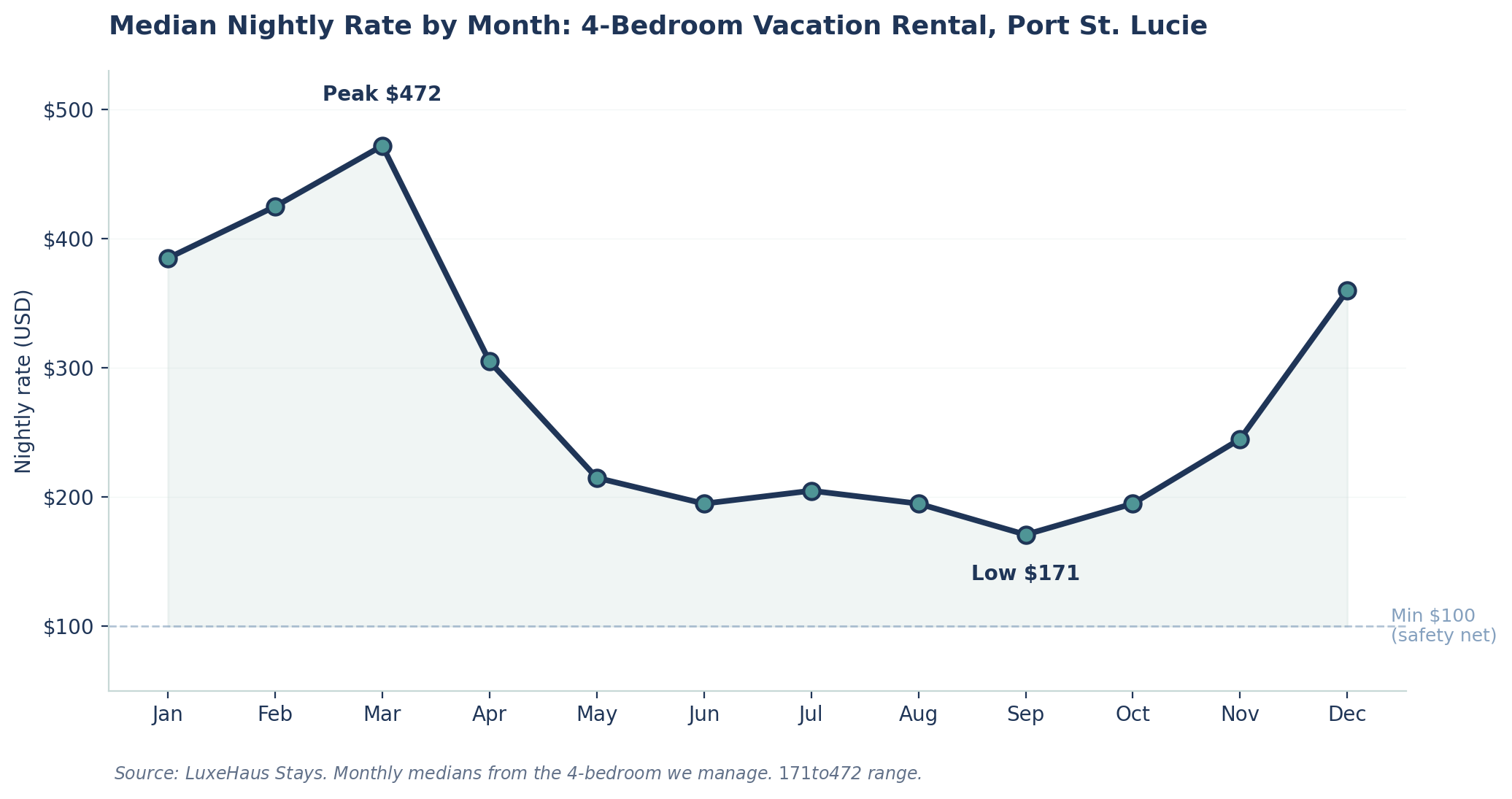
A Port St. Lucie 4-bedroom we manage is priced lowest in late summer, around $171 per night, and highest in February and March during Mets spring training, around $472 per night, with shoulder pricing through the golf season from October to April.
For Port St. Lucie property owners
The short-term rental rules
Port St. Lucie is one of the easier Florida cities to operate a short term rental in, with one catch that costs owners money if they miss it.
The good news on rules. The City of Port St. Lucie does not require a city-level short term rental permit or registration. That is a real advantage over the coast, where cities like Delray Beach restrict short term rentals by zoning. Here, the compliance stack is the statewide Florida DBPR vacation rental license, a St. Lucie County business tax receipt, and a county tourist development tax account. City parking and noise ordinances still apply, with quiet hours from 10 PM to 7 AM. Verify current rules before listing, since local ordinances change.
The catch: the tourist development tax. St. Lucie County charges a 5% tourist development tax on stays of six months or less. Airbnb and VRBO do not collect or remit this tax. Airbnb handles Florida state sales tax and the county surtax for you, which is why owners assume the county tax is covered too. It is not, and the same is true across Palm Beach, Martin, and St. Lucie counties. The tax stays your responsibility, due to the county the first of the month after each stay. Miss it and you owe the county directly, with penalties.
What the market does. A 4-bedroom in the Port St. Lucie market averages around $244 a night and grosses about $47,000 a year. A 4-bedroom we manage ranges from roughly $171 a night in the low season to $472 at the spring-training peak, which is how an average lands where it does. Market occupancy climbs from the low 50s in late summer to near 90% in February, when spring training and snowbird season overlap. A well-run home does better than the market average. We manage to that calendar, the spring-training spike, and the value-stay patterns here, not a generic pricing model.
For more on what running a short term rental in this region takes, see our guide to short term rental management on the Treasure Coast and Palm Beach County.
What LuxeHaus does. We run full-service short term rental management here for a flat 20% of gross booking revenue, with no hidden costs. We handle the licensing, the county tax registration, dynamic pricing, guest communication, and turnovers, with monthly tax filing available as an add-on. We are based in Palm Beach Gardens and serve Palm Beach, Martin, and St. Lucie counties. If you own a property here, we will show you what it could earn before you commit to anything.
Port St. Lucie, FL FAQ
Is Airbnb legal in Port St. Lucie?
Yes. Short term rentals are legal in Port St. Lucie, and as of 2026 the city does not require a city-level STR permit or registration. Owners do need a Florida DBPR vacation rental license, a Florida Department of Revenue sales tax account, and a St. Lucie County tourist development tax account, and they must collect and remit the 5% county tax themselves. City parking and noise ordinances apply.
Does Airbnb collect the tourist tax in St. Lucie County?
No. Airbnb and VRBO do not collect or remit the St. Lucie County 5% tourist development tax. Airbnb collects Florida state sales tax and the county discretionary surtax statewide, but it does not remit the county tourist development tax in St. Lucie, Martin, or Palm Beach counties. That tax remains the owner's responsibility, due to the county Tax Collector the first of the month after each stay.
Is Port St. Lucie a good place to buy a short term rental?
It can be, as a value play. Nightly rates run lower than the coast, but so do home prices, and demand is steady from golf, Mets spring training, and snowbird season. A 4-bedroom in the market averages around $244 a night and grosses about $47,000 a year, with the strongest months in February and March. The absence of a city STR permit makes it simpler to operate than most Palm Beach County cities.
When is Mets spring training at Clover Park?
The New York Mets hold spring training at Clover Park in February and March each year, as part of the Grapefruit League. The St. Lucie Mets minor-league team plays there through the summer. Spring training is the peak demand window for local short term rentals.
Sources and further reading
- City of Port St. Lucie. Official city website, departments, ordinances.
- St. Lucie County Tax Collector, Tourist Development Tax. The 5% county tax and who remits it.
- PGA Golf Club. Courses, rates, learning center.
- St. Lucie Mets and Clover Park. Spring training and minor-league schedules.
- Port St. Lucie, Florida (Wikipedia). History, demographics, growth.