
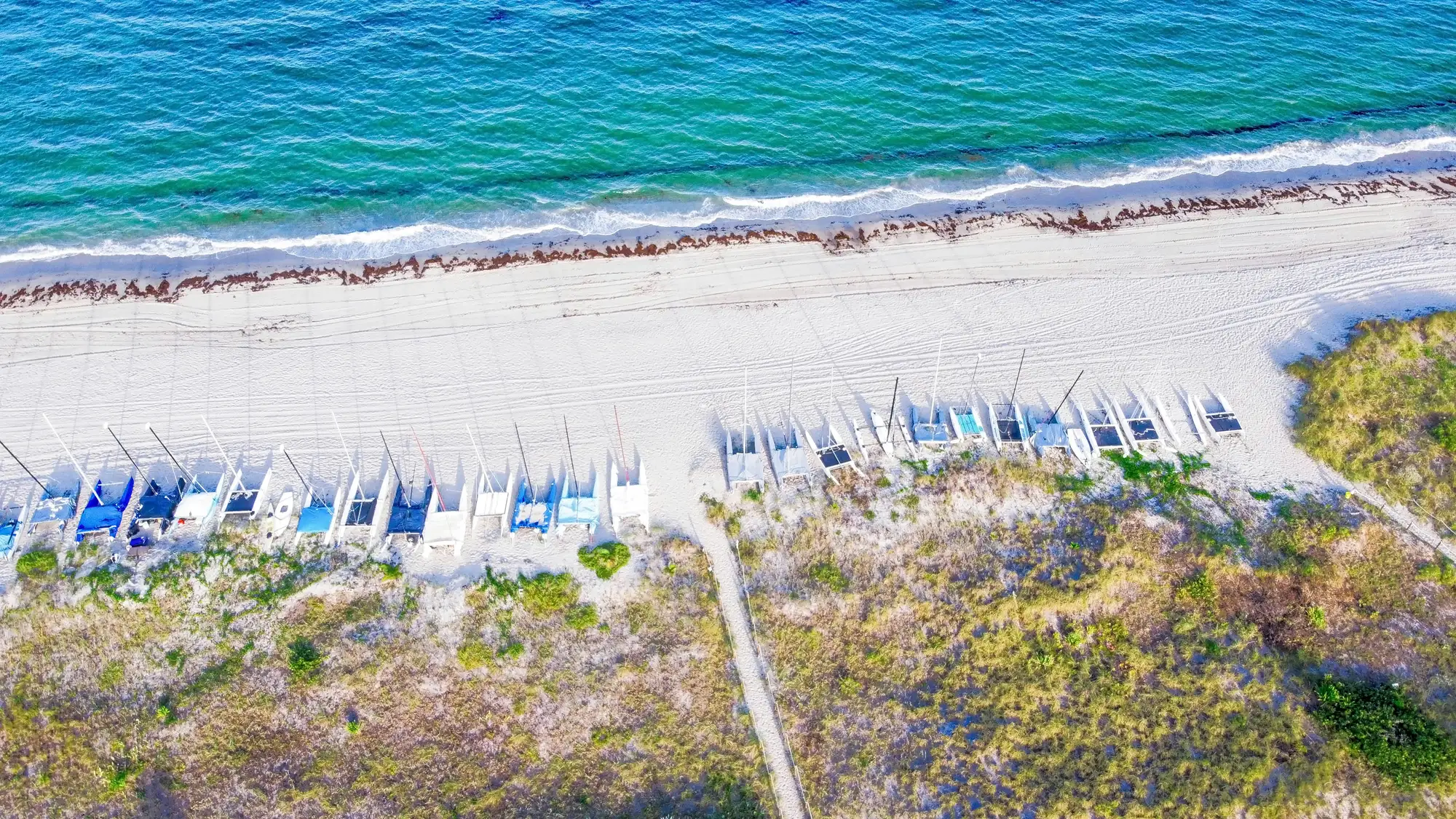
Delray Beach gets called the Village by the Sea, and the name fits. Downtown is Atlantic Avenue, about two miles of restaurants, galleries, and bars that runs from Swinton straight to a public beach. Guests can park once and walk the rest of the trip, which is rare in southeast Florida and is most of why they pick Delray over the towns around it. If you own here, or are thinking about buying, the thing to understand is the zoning rule that decides which properties can rent short term. We cover it in the owner section below.
Delray Beach, FL at a glance
- County
- Palm Beach
- Population
- ~67,000
- Source: US Census
- Founded
- 1894, incorporated 1911
- Source: Named for Delray, a Detroit neighborhood, by founder William Linton
- Main street
- Atlantic Avenue, about two miles from Swinton to the ocean
- Public beach
- About two miles of municipal beach
- Known as
- The Village by the Sea
- Vacation rental rules
- No city permit, but a zoning rule: max six rentals per year in single-family districts; short term rentals allowed in Medium Density Residential (RM)
- Source: Delray Beach LDR 4.3.3(ZZZ), as amended by Ordinance 21-26 (2026). Verify your property before listing
- County layer
- Florida DBPR license + Palm Beach County business tax receipt + 6% county tourist development tax
- Source: Palm Beach County Tax Collector
Where is Delray Beach, FL?
Delray Beach is a coastal city of about 67,000 people in Palm Beach County, sitting between Boynton Beach to the north and Boca Raton to the south, roughly 20 miles south of West Palm Beach and 50 miles north of Miami. It was founded in 1894 and incorporated in 1911. The founder, William Linton, named it after Delray, a neighborhood in Detroit.
What Delray Beach is known for
Mostly the downtown and the beach, plus an events calendar that is big for a city this size.
-
Atlantic Avenue
The spine of the city, running about two miles from Swinton Avenue east to the ocean. Restaurants, galleries, bars, and shops line both sides, and it stays busy on foot at night in a way most Florida downtowns do not.
-
The beach
About two miles of public municipal beach along A1A, with lifeguards, metered parking, and no high-rise wall blocking it. Anchor Park and Atlantic Dunes Park sit at the south end. The stretch is unusually open for southeast Florida, and it is a short walk or bike ride from downtown.
-
The Morikami Museum and Japanese Gardens
Sixteen acres of Japanese gardens, a museum, a bonsai collection, and a tea house, west of town. It traces back to the Yamato Colony, a Japanese farming settlement founded near here in 1905. George Morikami, one of the last surviving colonists, donated the land to Palm Beach County.
-
Pineapple Grove and the arts district
The blocks running north off Atlantic Avenue, marked by an archway and a run of murals, galleries, studios, and independent shops. It is where the city put its arts identity, and it gives downtown a second walkable axis beyond the main strip.
-
A festival calendar that drives bookings
The Delray Affair each April is one of the largest arts and crafts festivals in the Southeast. The Delray Beach Open brings ATP tour tennis to the Tennis Center in February. Garlic Fest, the Wine and Seafood Festival, and the downtown holiday tree fill in the rest. These weekends book out well ahead.
Delray sits in a dense run of coastal towns, and the short term rental rules change sharply from one to the next:
- Boynton Beach. Directly north. More residential and more affordable, with its own marina district and a business tax receipt plus certificate of use for short term rentals.
- Boca Raton. Directly south. Larger, wealthier, and considerably stricter: short term rentals are effectively prohibited in residential zones with a 30-day minimum and escalating fines.
- Highland Beach. A narrow barrier-island town between Delray and Boca, almost entirely residential condos and single-family homes.
- Gulf Stream. A very small, very affluent town immediately north along A1A. Largely private and residential.
- Lake Worth Beach. Further north, with a similar walkable-downtown character but a hard rule difference: short term rentals are not permitted there at all.
The neighborhoods that matter
Delray is compact, so the differences between areas are about walkability, lot size, and zoning rather than long drives. The main areas:
Beachside and Ocean Boulevard
Highest-end, walk to sand
Housing: Single-family homes and low-rise condos east of the Intracoastal, along and off A1A.
The read: The best nightly rates in the city, and guests can walk to both the beach and Atlantic Avenue. Also the most expensive homes to buy, by a lot.
Pineapple Grove
Arts district, walkable
Housing: A mix of townhomes, newer condo and mixed-use buildings, and older single-family homes just north of Atlantic.
The read: Walkable to everything downtown without paying beachside prices. Worth checking the zoning district carefully here, because the mix of housing types means the mix of zoning designations is wide.
Lake Ida
Big lots, mid-century, quiet
Housing: Mid-century single-family homes on unusually large lots northwest of downtown, some on the lake.
The read: More space and yard than anything closer in, and still a short drive to Atlantic Avenue. Mostly single-family zoning, which is the restrictive side of the city rule.
Del-Ida Park and the Marina district
Historic, close in
Housing: Two historic districts flanking downtown, with 1920s-era homes and strict exterior review.
The read: Character and location. Historic district rules add a layer on top of zoning for exterior work, so factor that into any renovation plan.
Osceola Park and the south downtown blocks
Close-in, changing
Housing: Older, more modest single-family homes and small multi-family just south of Atlantic.
The read: The most affordable way to be genuinely walkable to downtown. Mixed zoning, and the pocket where you are most likely to find a Medium Density Residential designation near the center.
Tropic Isle and Tropic Bay
Canal-front, boaters
Housing: Single-family homes on finger canals in the southeast corner, many with dockage and ocean access.
The read: Draws boating guests and buyers who want water out the back. Single-family zoning, so the turnover rule applies.
West of the city limits
Golf and country club, 55-plus
Housing: Large gated and country club communities with Delray Beach mailing addresses, much of it in unincorporated Palm Beach County.
The read: Read the owner section below before you assume city rules apply here. Many of these addresses are not inside the City of Delray Beach at all, and HOA rules are usually the binding constraint instead.
Things to do
Most of it sits between Atlantic Avenue and the sand. A few things are worth the short drive west.
-
Walk Atlantic Avenue
Start here. Two miles of restaurants, galleries, and bars from Swinton to the ocean, best on foot and best in the evening.
-
Morikami Museum and Japanese Gardens
Sixteen acres of gardens across six distinct styles, a bonsai collection, a museum, and a tea ceremony program. Allow half a day.
-
Delray Municipal Beach
Two miles of public sand with lifeguards and metered parking along A1A. Anchor Park and Atlantic Dunes Park anchor the quieter south end.
-
Wakodahatchee Wetlands
A three-quarter-mile boardwalk over constructed wetlands, and one of the best birding spots in South Florida. Free, and busiest at sunrise. Green Cay Nature Center nearby is the companion stop.
-
Pineapple Grove Arts District
Murals, galleries, studios, and independent retail on the blocks north of Atlantic Avenue.
-
The Delray Beach Tennis Center
Host of the Delray Beach Open, an ATP tour stop each February. Public courts the rest of the year.
-
Old School Square
The cultural campus at Atlantic and Swinton, built around the restored 1913 school buildings, with a museum, a theatre, and an outdoor pavilion that programs concerts and events.
A day trip worth the drive
-
The Boynton and Lantana beaches, and Boca to the south
Delray sits in the middle of a continuous run of barrier-island beach. Twenty minutes north gets you to Lantana and Manalapan, twenty minutes south to Boca Raton and Red Reef Park, all reachable on A1A without touching I-95.
Where to eat
Nearly everything on this list is on Atlantic Avenue or a block off it.
- Boston's on the Beach. On A1A across from the sand since 1979. Casual, loud, and the closest thing Delray has to an institution.
- The Grove. Contemporary American in Pineapple Grove, one of the stronger dinner rooms off the main strip.
- Sundy House. Dining inside a restored 1902 home surrounded by tropical gardens. The Sunday brunch is the local reference point.
- City Oyster & Sea Grill. Seafood and a raw bar on Atlantic Avenue, long-running and reliably busy.
- Elisabetta's Ristorante. Big Italian room at the east end of Atlantic, with a patio aimed at the street.
- Death or Glory. A bar and kitchen in a restored historic building on NE 2nd Avenue, known for the cocktail program.
- Doc's All American. A 1951 walk-up ice cream and burger stand at Atlantic and Swinton. A landmark more than a meal.
- The Office. Gastropub on Atlantic, a long-standing downtown default.
When to come
High season runs December through April, and Delray’s event calendar sharpens it further. The Delray Beach Open in February and the Delray Affair in April both pull hard on the rental calendar. Summer is hot but still books on weekends. September and October are the bottom.
Peak: December through April
Snowbird season stacked on top of the event calendar. The Delray Beach Open in February and the Delray Affair in April are the two dates that move rates most. Book early and expect minimum stays.
Shoulder: May and November
Warm water, thinner crowds, and noticeably softer rates. A good window for longer stays.
Summer: June through August
Hot and humid, with afternoon storms. Atlantic Avenue and the beach still carry weekend demand, and this is when regional drive-in guests show up.
Slowest: September and October
The bottom of the calendar, and peak hurricane season. Rates are lowest here, and longer stays are usually the better way to fill it.
For Delray Beach property owners
The short-term rental rules
Delray Beach works for short term rentals, but there are some restricted areas. The rule is about zoning, and most of what you will read online gets it wrong.
There is no city permit, but there is a zoning rule. Delray has nothing to register or apply for at city hall, which is why many guides call it wide open. The actual rule sits in the zoning code: in single-family districts, you cannot rent your home out more than six times in one year (Land Development Regulations Section 4.3.3(ZZZ)). In Medium Density Residential (RM) districts, short term rentals are allowed. Six is the ceiling for the whole year, not six a month. A nightly rental typically turns over 40 to 60 times a year, so a single-family Delray home cannot run that way. It can still host a handful of long seasonal stays, roughly six stretches of two months. Nightly rental is an RM-district business here, which makes the zoning district the first thing to check on any Delray address.
The rule got friendlier in April 2026. The limit had been three stays a year since 2012. The city repealed that this spring because it conflicted with Florida law, went back to the original six-stay limit from 2009, and confirmed short term rentals as an allowed use in RM districts. Any guide that says the limit is three is out of date.
Many Delray Beach addresses are not in the city. A lot of homes west of town have a Delray Beach mailing address but sit in unincorporated Palm Beach County, where the city rule does not apply. Those addresses are simpler on paper, though the gated communities out west usually have HOA rules stricter than anything the city would impose. Confirm the jurisdiction first.
The state and county layer still applies. Every Delray short term rental needs a Florida DBPR vacation rental license, county and city business tax receipts (the city one is about $190), and a Palm Beach County tourist development tax account. The county tax is 6%, Airbnb does not remit it, and returns are due monthly, even in months with no bookings.
For how Delray compares to the rest of the county, see our guide to where you can run a short term rental in Palm Beach County. Rules in neighboring West Palm Beach differ substantially.
What LuxeHaus does. We run full-service short term rental management for a flat 20% of gross booking revenue, with no hidden costs. We handle licensing, county tax registration, dynamic pricing, guest communication, and turnovers, with monthly tax filing available as an add-on. We are based in Palm Beach Gardens and serve Palm Beach, Martin, and St. Lucie counties. In Delray we confirm the zoning district before taking on a property.
This page is general information, not legal advice. Zoning designations and ordinances change. Confirm the current rule and your parcel’s zoning district with Delray Beach Development Services before buying or listing.
Delray Beach, FL FAQ
Can you run a short term rental in Delray Beach?
Yes, in the right zoning district. Delray Beach does not issue a vacation rental permit. Instead, city zoning prohibits renting a home out more than six times in one year in single-family districts (Land Development Regulations Section 4.3.3(ZZZ)). In Medium Density Residential (RM) districts, short term rentals are allowed. Confirm the zoning district for the specific property with the city before you buy or list.
Does Delray Beach require a vacation rental license?
The city does not run a vacation rental permit or registration program, and it eliminated landlord permits in October 2023 following state legislation. That absence is why many guides describe Delray as unrestricted, which is misleading. A business tax receipt is still required, currently around $190. Above that you need a Florida DBPR vacation rental license, a Palm Beach County business tax receipt, and a county tourist development tax account. The zoning rule sits on top of all of it.
Why did Delray Beach change its short term rental rule in 2026?
Delray limited rentals to six a year in 2009, then cut the limit to three in 2012. Florida Statute 509.032(7)(b) bars cities from restricting vacation rentals through ordinances adopted after June 1, 2011, but lets older rules stand. The 2009 rule survives; the 2012 change did not. In April 2026 the city adopted Ordinance 21-26, which removed the conflicting language, restored the six-a-year limit, and confirmed short term rentals as an allowed use in Medium Density Residential districts.
Does Airbnb collect the tourist development tax in Palm Beach County?
No. Airbnb collects Florida state sales tax and the county discretionary surtax, but it does not remit the Palm Beach County 6% tourist development tax. The Palm Beach County Tax Collector states plainly that the host must collect and remit it. Returns are filed monthly, due on the first and late after the twentieth, and a zero-dollar return is still required in months with no bookings. Our Palm Beach County tourist development tax guide covers registration and filing step by step.
Is a property with a Delray Beach address always inside the city?
No, and this catches buyers regularly. A large amount of land west of the city carries a Delray Beach mailing address while sitting in unincorporated Palm Beach County. Those parcels are not governed by the city zoning code, so the city turnover rule does not apply to them. Unincorporated Palm Beach County has no county-level short term rental permit, which makes those addresses simpler on paper, though the HOA rules in the large communities out there are often restrictive. Check which jurisdiction a parcel actually sits in before relying on either rule.
Sources and further reading
- City of Delray Beach. Official city website, departments, and the Land Development Regulations.
- Florida Statute 509.032. The state preemption provision and the June 1, 2011 grandfather date.
- Palm Beach County Tax Collector, Tourist Development Tax. The 6% county tax, registration, and monthly filing.
- Morikami Museum and Japanese Gardens. Hours, gardens, and the Yamato Colony history.
- Delray Beach, Florida (Wikipedia). History, demographics, and geography.