
A 4-bedroom vacation rental we manage swung between $171 and $472 a night last year. Same house, same beds. The difference between owners who capture that swing and owners who don't is $20,000 or more in annual revenue. Pricing is the operational decision with the biggest impact on owner revenue, and it's the one most Florida vacation rental owners get wrong.
Here are five pricing mistakes we see most often when we audit Florida vacation rentals, in order of how much money they leak. We caught number one on our own property six months in.
Mistake #1: Trusting the default last-minute discount
Most pricing tools default to a 20% to 30% nightly discount on the last 7 to 15 days before check-in. That logic makes sense for a 50% booked calendar. For a property that already books 90%+ at a 2 to 3 day lead time, the default is pure margin loss. Tune the last-minute factor to 0% to 5%.
The default last-minute discount is built for the average property in the average market: half-booked, anxious to fill the calendar. If your property is consistently in the top quartile for occupancy in its market, the default is bleeding you for nothing.
A quick definition. Booking lead time is the gap between the day a guest books and the day they check in. The market average across Florida vacation rentals has historically been about three weeks. In Palm Beach, Martin, and St. Lucie counties, that number has been shrinking for several years. The property we currently manage runs at a median two to three day lead time, well below the market average. Guests decide later. The default discount window has not caught up.
On the 4-bedroom we manage, which consistently runs above 85% occupancy with a median 2 to 3 day booking lead time, the default 15% last-minute discount over 6 days was discounting bookings that would have happened anyway. We changed it to 5% over 14 days on April 22, 2026, and the calendar kept filling at higher rates. When the calendar softened in late summer we moved it back up, which is the point: the setting follows your booking pace, not a rule.
This is the easiest single change to make. Open your dynamic pricing tool, find the last-minute discount factor, and reduce it. If your occupancy is consistently above 80% in your market, drop it to 0% to 5%. If you're booking at 50% to 70%, leave it closer to the default. To see where your own window starts, read our guide on whether to lower your Airbnb price when the calendar is empty.
The trap: many owners assume "discount = more bookings." For high-demand properties, the bookings happen regardless of the discount. You're just leaving money on the table. This is the kind of default that makes hosts wonder whether the tool is even working, which is why we wrote a full take on whether PriceLabs is worth it.
Mistake #2: Setting your minimum price too high
Most owners apply break-even math that includes the cleaning fee, then set $250 or $280 as the nightly floor. The cleaning fee is charged on top, not inside the nightly rate. Real cash break-even on a 4-bedroom in this market is closer to $20 to $50. A $100 floor is a safety net, not a profit gate.
This one took us a while to internalize. When you first set up dynamic pricing, the tool asks for a minimum acceptable nightly price. The instinct is to add up everything the property costs (utilities, mortgage share, cleaning supplies, taxes), divide by booked nights, and use that as the floor. You arrive at $280 and call it a day.
The guest already pays a separate cleaning fee on top of the nightly rate. On most listings that is $150 to $250 per stay. If you collect that fee 100 times a year, it covers a real chunk of your annual operating costs before the nightly rate has done any work. When you build your floor on the assumption that the nightly rate alone has to pay for cleaning costs, you are charging the guest twice for cleaning: once in the line-item fee, and once buried inside the nightly rate.
Once you back the cleaning fee out of the math, the true nightly break-even on a typical 4-bedroom in Palm Beach or the Treasure Coast lands closer to $20 to $50. Setting your minimum at $100 is a safety net against pricing errors, not a financial risk. The dynamic pricing tool will almost never actually hit the floor, because real demand sets a higher price most of the time.
Setting the minimum too high means your calendar sits empty during shoulder seasons. An empty night at $250 you didn't get is worse than a booked night at $130 you did.
For context on what Florida vacation rentals earn across the rate spectrum, see our breakdown of what Airbnb income looks like in Palm Beach County.
Mistake #3: Same nightly rate on every channel
Airbnb's host fee is 15.5%. VRBO's is 8% (5% commission plus 3% payment processing). If you charge the same nightly rate on both, every Airbnb booking nets you less than the same night on VRBO. Add an Airbnb rate adjustment of about +18.3% to net the same per night on both platforms.
Here's the math on a $300 nightly rate:
- VRBO: guest pays $300, host nets $276 after the 8% fee
- Airbnb: guest pays $300, host nets $253.50 after the 15.5% fee
- Same night, same property, $22.50 difference
Multiply that across a busy year, and it's $1,500 to $3,000 in revenue gone with no line item to show for it. The fix is to add a channel-specific rate adjustment on Airbnb so that your post-fee net matches what VRBO delivers. We call this the Net-Parity Markup. The guest never sees a separate fee; Airbnb shows one all-in price. The math just rebalances who absorbs the platform's cut. If your listing moved off Airbnb's split fee in September 2026, read what the 15.5% host-only fee changed and how much to raise before setting this markup.
The markup math
Why 18.3% and not 15.5%?
Most owners assume the answer is to mark up by 15.5% since that's the fee. It isn't, and the reason is worth understanding. Airbnb takes 15.5% of whatever price the guest sees, not the original. So when you mark up, their cut gets bigger too. You have to mark up by enough that what's left after their bigger cut still equals your target.
Say your target net is $300, which is what you'd make on VRBO at this rate.
Wrong: mark up by 15.5%
- Guest pays $346.50
- Airbnb takes 15.5% = $53.71
- You net $292.79
- $7.21 short of target
Right: mark up by 18.3%
- Guest pays $354.90
- Airbnb takes 15.5% = $55.01
- You net $299.89
- Matches VRBO ✓
The shortcut: Airbnb keeps 15.5% of every dollar, so you keep 84.5%. To end up with one dollar in your pocket, the guest needs to pay enough that 84.5% of it equals one dollar. That's $1 divided by 0.845, which is $1.183, or a 18.3% markup. The formula in one line: 1 / (1 - 0.155) - 1 = 0.183.
You can calculate your own Net-Parity Markup using the interactive tool further down this post. Plug in any nightly rate and see what each channel pays you, before and after applying the markup.
Two caveats. First, set the Airbnb markup once and leave it alone. It is a permanent adjustment to make up for Airbnb's higher platform fee, not a knob to turn down when bookings are slow. If your calendar is soft, the fix is dynamic pricing, better photos, or a more competitive base rate, not lowering the Airbnb markup. Second, this assumes you also list on VRBO. If you are Airbnb-only, the markup point is moot. Worth fixing that too. VRBO commonly drives 30% to 40% of nights on Florida vacation homes.
Mistake #4: Flat pricing through the seasons
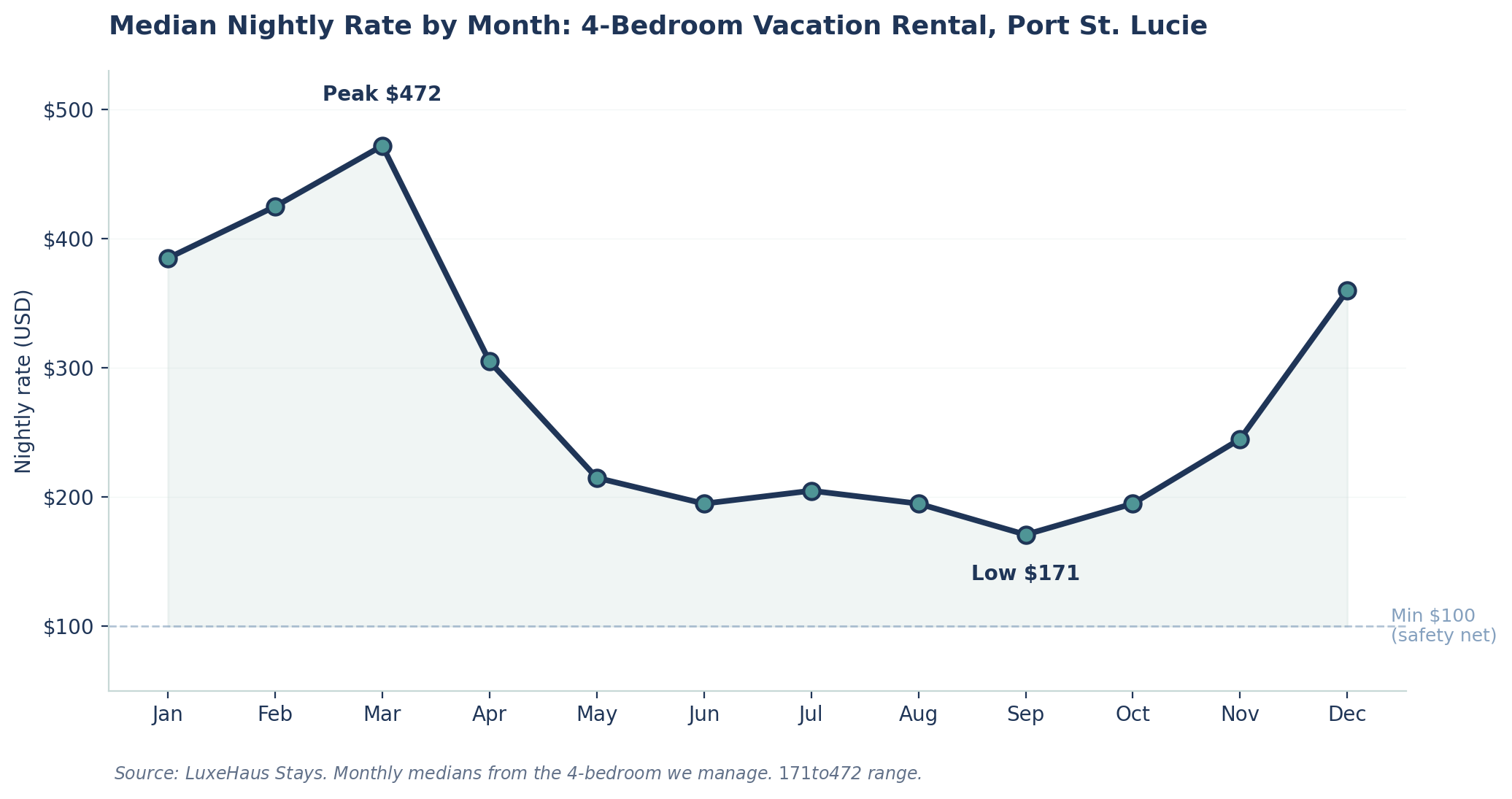
The same 4-bedroom we manage ranges from $171 a night in low season to $472 in peak season. Owners who set one rate (say $285) lose in peak season and book nothing in low. Use dynamic pricing.
Florida has more pricing windows than most owners realize, and they layer on top of each other:
- Snowbird season (December to March). Northern visitors come for the warmth. Multi-week stays at premium rates.
- Spring training (late February to late March). The Mets train in Port St. Lucie. The Red Sox in Fort Myers. The Cardinals in Jupiter. Demand spikes on weekends when families fly in for games.
- Cognizant Classic (late February to early March). PGA Tour event at PGA National in Palm Beach Gardens. Premium pricing within a 15-mile radius of the course.
- Spring Break (mid-March to mid-April). Family travel surge. Three- to four-night minimum makes sense.
- Summer (June to August). Heat plus hurricane lulls. Lower rates, longer stays, more domestic travelers.
- Major holidays. Memorial Day, Independence Day, Thanksgiving, Christmas, and New Year's Eve all command 1.5x to 2x normal rates.
A flat rate misses every one of these. The owner with a $285 flat price loses bookings to the comp at $171 in July, and loses revenue to the comp at $472 over New Year's. The right pricing tool adjusts daily based on local demand, day of week, and how full the calendar is for upcoming dates.
This is also why a vacation rental in Palm Beach County requires more than just a license. Licensing is the compliance layer, and capturing the revenue is the work that follows.
Agent resource
Real estate agents:
Free Florida revenue estimates and STR feasibility checks for your buyer clients. Learn more about our agent program.
Mistake #5: No discount for early bookers
Most owners discount late, not early. Counterintuitive: a small 5% to 8% discount on dates 45 days or more out captures booking demand from planners and families before they shop competitors. It's a lead-time strategy, not a desperation discount.
There are two kinds of guests who book your property. Last-minute deciders who are choosing between three options the day before, and planners who are locking in a vacation 6 to 12 weeks ahead. Most pricing setups discount the first group and ignore the second.
The planners are easier money. They've already committed to traveling on specific dates. They're not waiting for a deal. A small 5% to 8% discount on far-out dates rewards them for the certainty they give you, and pulls bookings from competitors who haven't thought about lead-time pricing.
We use an 8% discount on dates 45 or more days out on the property we manage. It pulls roughly the same booking volume as the last-minute discount used to pull, except those bookings are now confirmed two months out instead of two days out. That predictability has cascading benefits for cleaning scheduling, supply orders, and pricing the rest of the calendar.
The trap to avoid: making the far-out discount large. Anything more than about 10% starts cannibalizing your peak-season pricing. The point is to nudge planners into committing, not to undercut your own rate card.
Try the Net-Parity Markup yourself
Plug in any nightly rate. See what each channel pays you, the per-night gap, and the marked-up Airbnb price that nets the same as VRBO.
Airbnb (15.5% host fee)
VRBO (8% total fees)
Net gap per night
$22.50 (8.9% less on Airbnb)
The fix: Net-Parity Markup
Set your Airbnb rate to $354.91 (a +18.3% adjustment on the base). Your Airbnb net then matches VRBO at $300.00.
Fees current as of May 2026. Airbnb 15.5% host-only fee (in effect since October 27, 2025), VRBO 5% commission plus 3% payment processing.
The calculator above runs the math live. The fix is just three settings in your channel manager: a +18.3% Airbnb rate adjustment, an unmarked-up rate on VRBO, and the same base price feeding both. Then your nightly net is the same regardless of which channel the guest happens to find you on.
The combined math
If you're making all five mistakes:
- Mistake #1 leaks about $1,500 to $3,000 a year in last-minute over-discounting on a high-occupancy listing
- Mistake #2 holds your shoulder season empty when a properly-set floor would have booked it: another $2,000 to $5,000
- Mistake #3 costs $1,500 to $3,000 a year on the Airbnb vs VRBO net difference
- Mistake #4 surrenders 50% of the peak-season uplift to comps: $8,000 to $15,000 on a busy 4-bedroom
- Mistake #5 misses planner bookings: $1,000 to $3,000
On a 4-bedroom in Palm Beach County, the realistic combined leak is between $14,000 and $29,000 a year. Take the midpoint and round: about $20,000 a year on a busy 4-bedroom. Most owners can recover the majority of that by fixing two of the five.
The harder question is whether you want to spend the time learning a pricing tool, monitoring comp sets, and adjusting settings monthly. Some owners run this themselves and do it well. Others would rather have someone else run it. If pricing is the only piece you want handled, our short-term rental revenue management service does exactly that for a flat monthly fee, with no cut of your revenue. For everything else, our Florida short-term rental management page lays out what's included.
Frequently asked questions
What's the right minimum price for a Florida vacation rental?
Set the minimum nightly price as a safety net, not a break-even calculation. On a typical 4-bedroom in Palm Beach or the Treasure Coast, $100 is a reasonable floor. The dynamic pricing tool will almost never hit it. Setting the floor at $250 or higher leaves shoulder-season nights empty.
Should I charge the same nightly rate on Airbnb and VRBO?
No. Airbnb's host fee is 15.5%. VRBO's is 8%. If you charge the same rate, Airbnb nets you about $75 less on a $1,000 booking. Add a +18.3% rate adjustment on Airbnb to net the same per night across both platforms. The guest sees one all-in price; the math just rebalances who absorbs the platform fee.
How often should I update my pricing?
Daily, ideally automated. Florida demand swings on holidays, weather, sports events, and weekday vs weekend in ways no manual schedule can capture. A dynamic pricing tool that syncs to your channel manager every 4 to 6 hours is the right setup. Manual updates once a week or once a month leave too much revenue on the table.
Do dynamic pricing tools work for portfolios of one or two properties?
Yes. The math doesn't change with portfolio size. A single property with the right pricing setup can outperform a portfolio of ten with static pricing. PriceLabs and Beyond are both used by single-property owners. The monthly cost ($20 to $30) typically pays for itself within the first peak weekend.
How much does dynamic pricing actually move revenue?
Range varies widely. We see 15% to 30% revenue lift on properties switching from manual pricing to a tuned dynamic pricing setup. The lift comes from capturing peak-week premiums that owners didn't know to charge, plus filling shoulder-season nights at rates that work. The lift on under-tuned dynamic pricing setups is smaller, often 5% to 10%, which is where most owners get stuck.
General information about short-term rental pricing, not personalized financial advice.